
Curiosity Motivated the Cat to Resolve its Knowledge Gap
Humans are inherently and insatiably curious beings. We have a very strong desire to know and curiosity is one of our most basic, universal human traits. Without the primal urge to peak behind the curtain or see what lies on the other side of the ocean, beyond the atmosphere or within ourselves, we would quite literally still be stuck in the stone age. Simply, curiosity has been one of the key drivers towards our evolutionary dominance.
The curiosity that we have as human beings lends itself towards our proclivity for the unknown and unfinished. We absolutely hate not knowing and not finishing something once our interest has been peaked. A while ago there was a TV Series called Flashforward. Basically, the show was about how everyone on Earth had blacked out for 2 minutes at the same time and had a vision 6 months into the future. The show was rather binge-worthy (for myself at least) and when it ended, it did so on a typical season finale cliffhanger. And then, poof, cancelled. No resolution, no understanding of why certain events transpired, nothing. It bugs me still to this day.
This is just one example of our human tendency towards wanting to know. George Loewenstein wrote a rather definite paper on the subject of curiosity, and I was fortunate enough to attend some of his lectures during my studies. Essentially, what he and other authors on the subject state is that curiosity is borne out of our attention being directed towards a knowledge gap. These knowledge gaps essentially produce the feeling of deprivation which is labeled as curiosity. The curious individual thus becomes motivated to obtain the missing information to fill the knowledge gap and consequently eliminate the feeling of deprivation and satisfying their curiosity.
Curiosity can thus be viewed as a primal driver of human innovation and its importance as a motivating force is not lost in the world of behavioural economics. The finer details of curiosity are also rather interesting. The thing about knowledge gaps is that they can be large or small and action very much depends on their size. A small knowledge gap is when you as an individual have a relatively large amount of information about a specific subject or topic. A large knowledge gap is, obviously, the inverse: a paucity of information. In terms of curiosity, the more you know, the more you want to resolve your knowledge gap. However, there is a threshold. Know too much and there is no more reason to be curious. Let me give you an example: imagine you are completing a 500 piece puzzle and you have never seen the picture it will eventually become. The more pieces you have completed, the more eager you are to finish. If, however, you start the puzzle with 470 pieces completed, you already know too much and the drive to resolve your curiosity is decreased and your behaviour follows suit.
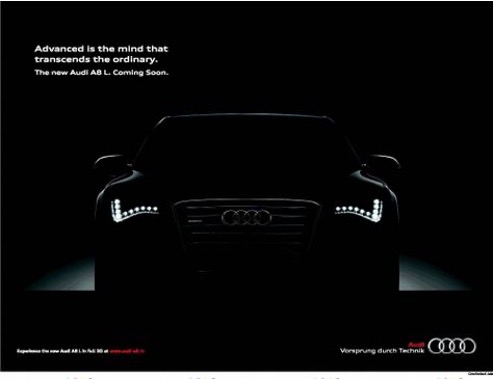
The advertising industry has been using curiosity as a driver for years with varying degrees of success. Generally, advertisers utilize curiosity in the form of a teaser ad, something like this Audi advert to the right. This advert uses curiosity very well because you, as a customer, can see that it is a new Audi A8 and you can see some (but not all) of the general shape. Therefore, you are keen to resolve your curiosity by finding out the complete picture in terms of what it looks like inside and outside and the specs around how it performs. Well played Audi. So who doesn't use curiosity wisely? Well, the film industry is notoriously bad and often poor trailers are a direct cause of poor audience reception. Case in point: Batman vs Superman. Coming in with a Rotten Tomatoes score of 27% (terrible) the film received widespread criticism and was, in general, not great. One of the biggest criticisms was that the trailers gave away the entire plot. In the 2 minutes and 30 seconds the trailers had, they managed to reveal spoilers, character inclusions, and story arcs which left audiences leaving the film with a feeling of the whole event being anti-climactic. This type of curiosity mismanagement can have serious implications for the studios leading to cancellation of further films within franchises. Luckily for both Batman and Superman, Wonder Woman came to the rescue to steady the franchise.
Curiosity is a fantastic tool in the behavioural economics toolbox, but its effects, limits and implications need to be well understood before they can be leveraged. Once you capture someone's curiosity, you have their attention and they can be nudged in various ways because of our innate human proclivity for not wanting to be left without knowing. Instead of curiosity killing the cat, it can motivate the cats actions in specific and predictable ways.
Continue reading
Behaviour Explains Business
Every commercial metric is the shadow of a human decision. Understanding the behaviour that created the metric is where better decisions begin.
7 min readWhy Good Consumer Outcomes Can't Be Regulated Through Disclosure Alone
Disclosure assumes information becomes understanding, and understanding becomes better decisions. Behavioural science suggests neither step is guaranteed — and that has profound implications for consumer protection.
6 min readDon't Read This Article...Unless You Want to Know More About Psychological Reactance
The moment someone tells us not to do something, a little voice inside says, 'Well now I have to.' That impulse isn't childish stubbornness. It's a well-documented psychological phenomenon called reactance.